
Root Canal vs Tooth Extraction – What Should You Choose? Dentist Explains
Root Canal vs Tooth Extraction – What Should You Choose? Dentist Explains
Tooth pain can be overwhelming, and when it becomes unbearable, most adults are left choosing between two major dental treatments—root canal treatment or tooth extraction. Both options aim to get rid of pain and infection, but they work very differently and have long-term consequences for your oral health.
In this detailed guide, we break down when a root canal is the better option, when extraction becomes necessary, and how to choose the right treatment for your dental condition. If you’re confused and need clarity, this dentist-approved 2025 guide will help you make an informed decision.
Understanding Root Canal Treatment (RCT)
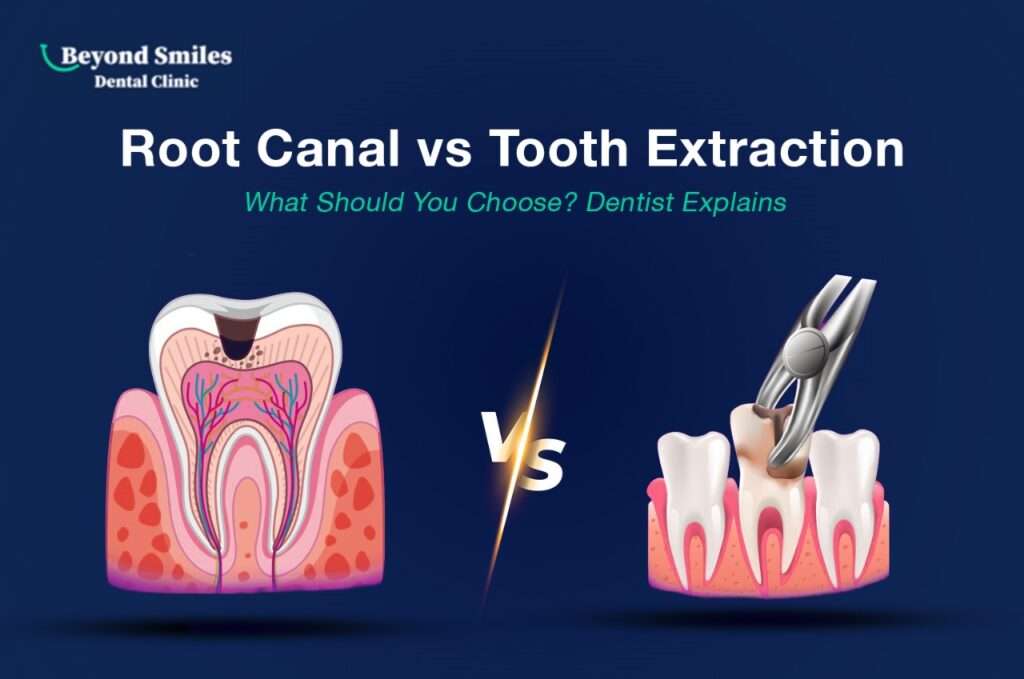
A root canal treatment is done when the inside of the tooth—the pulp—is infected or inflamed. Instead of removing the tooth, the dentist removes the infected pulp, cleans the canal, disinfects the tooth, and seals it. After healing, a dental crown is usually placed to restore strength and appearance.
Benefits of Root Canal Treatment
✔ Saves Your Natural Tooth
Keeping your natural tooth is always the best option for chewing, stability, and jaw health.
✔ Painless and Quick in 2025
With modern rotary systems, anesthesia, and digital X-rays, root canals are comfortable and minimally invasive.
✔ Prevents Tooth Loss Complications
Losing a tooth leads to shifting of nearby teeth, jawbone loss, and chewing issues.
✔ Cost-Effective Long Term
Compared to dental implants or bridges, saving a tooth is more affordable and requires less complex work.
When Dentists Recommend a Root Canal
- Deep cavities causing infection
- Severe tooth sensitivity
- Facial/ gum swelling
- Cracked or fractured tooth (if restorable)
- Pain while chewing or biting
- Abscess near the tooth root
If the structure of the tooth is still strong, root canal + dental crown is the ideal solution.
Understanding Tooth Extraction
A tooth extraction removes the tooth entirely from its socket. This is usually done when the tooth is damaged beyond saving or poses a risk to surrounding teeth.
Benefits of Tooth Extraction
✔ Quick Relief from Severe Infection
If the infection is too advanced, extraction immediately prevents it from spreading.
✔ Necessary When the Tooth Cannot Be Restored
Severely broken, decayed, or fractured teeth may not be strong enough for a root canal.
✔ Useful for Orthodontic Cases
In some braces or aligner treatments, extraction is needed for alignment correction.
When Dentists Recommend Tooth Extraction
- Tooth is broken below the gum line
- Fractured root
- Tooth has no supporting bone left
- Severe gum disease
- Failed previous root canal
- Non-restorable condition
In such cases, saving the tooth may not be possible.
Root Canal vs Tooth Extraction: Detailed Comparison
| Feature | Root Canal Treatment | Tooth Extraction |
| Pain | Minimal | Minimal to mild post-op |
| Time Required | 1–2 sittings | Single sitting |
| Cost | Moderate | Low initially |
| Healing Time | 1–3 days | 7–10 days |
| Chewing Efficiency | Restored completely | Reduced unless replaced |
| Jawbone Health | Preserved | Bone loss occurs |
| Long-Term Benefit | High | Depends on replacement |
Why Dentists Prefer Root Canal Over Extraction (When Possible)
Dentists generally prefer saving the natural tooth because:
1️⃣ Natural Teeth Are Stronger Than Artificial Replacements
Even advanced dental implants cannot fully match the strength of natural root structures.
2️⃣ Better Chewing Function
A saved tooth allows better bite force and stability.
3️⃣ Prevents Bone Loss
After extraction, the jawbone in that area begins to shrink—a process called bone resorption.
4️⃣ Maintains Natural Smile & Alignment
Removing a tooth creates gaps that cause nearby teeth to tilt or move.
5️⃣ More Cost-Effective Than Replacements
Tooth replacement options like implants, bridges, or dentures cost significantly more.
For these reasons, most dentists consider a root canal the first choice unless extraction is absolutely necessary.
When Extraction Is the Better Choice
Even though saving teeth is ideal, some conditions make extraction unavoidable:
✔ Severe decay where no tooth structure remains
✔ Root fractures (especially vertical fractures)
✔ Repeated infections even after RCT
✔ Teeth with poor bone support due to gum disease
✔ Impacted wisdom teeth causing pain or infection
In such cases, removing the tooth is the most predictable and safe treatment.
What Happens After Extraction?
To avoid long-term problems, dentists usually recommend replacing the missing tooth with:
🔹 Dental Implants – Strongest and longest-lasting
🔹 Dental Bridges – Fixed and natural-looking
🔹 Partial Dentures – Removable alternative
If you do not replace the extracted tooth, you risk:
- Jawbone shrinkage
- Facial sagging
- Misaligned teeth
- Chewing difficulty
- TMJ (jaw joint) problems
This is why dentists emphasize planning the replacement immediately after extraction.
Pain Comparison: Root Canal vs Extraction
Many patients assume extractions are easier, but here’s the reality:
📌 Root Canal
- Local anesthesia makes it painless
- Mild pressure felt, no sharp pain
- Smooth recovery
📌 Extraction
- Also painless during the procedure
- Post-extraction swelling & discomfort are common
- Requires careful aftercare
Modern dentistry ensures both procedures are safe and comfortable.
Which Is More Affordable?
Root Canal Cost Components:
- Complexity
- Tooth location
- Need for dental crown
- Clinic experience
Extraction Cost Components:
- Simple or surgical
- Tooth position
- Need for replacement (implants/bridges)
While extraction appears cheaper at first, replacing a missing tooth later increases the total expense.
So, What Should You Choose?
✔ Choose Root Canal if the tooth is restorable, has good structure, and can be saved.
✔ Choose Extraction only if the tooth is beyond repair or saving it puts your oral health at risk.
The best decision always comes from a proper clinical evaluation including digital X-rays, OPG scans, intraoral exams, and specialist assessment.
Trusted dental clinics in Bangalore like Beyond Smiles Dental Clinic follow a conservative approach—save the natural tooth whenever possible and recommend extraction only when absolutely necessary.
Beyond Smiles Dentist-Recommended Care
Beyond Smiles Dental Clinic (Indiranagar, Koramangala, Kanakapura Road), we believe brushing is the foundation of oral health. But brushing alone may not always be enough.
Our dental experts can help with:
- Professional cleaning (scaling & polishing)
- Demonstrations of the right brushing methods for kids, braces, and seniors
- Advice on the best toothbrush type for your unique needs
- Treatment of sensitivity, gum bleeding, or enamel wear caused by brushing mistakes.
Find Your Nearest Beyond Smiles Clinic
Koramangala – 6th Block Beyond Smile Dental Clinic
Call – +91 8431493475
Address: WJPF+285, KHB Colony, 6th Block, Koramangala, Bengaluru, Karnataka 560095
Koramangala – 7th Block Beyond Smile Dental Clinic
Call: +91 98867 24383
Address: #358, 1st Floor, 1st Main Road, 7th Block, Koramangala, Bengaluru, Karnataka 560095
Indiranagar – Beyond Smile Dental Clinic
Call – +91 76248 65553
Address: 285, 6th Cross Rd, near Indiranagar, Binnamangala, Hoysala Nagar, Indiranagar, Bengaluru, Karnataka 560038
Kanakapura Road – Beyond Smile Dental Clinic
Call – +91 98867 24383
Address: 69, Shivaganga Spatica, 3rd Main Rd, Kanakapura Main Rd, Manjunathnagar, Raghuvanahalli, Subramanyapura, Bengaluru, Karnataka 560109
Final Thoughts
Every tooth is unique, and so is every dental case. While online information helps you understand the difference, only a professional dentist can guide you accurately.
Whether it’s root canal treatment, tooth extraction, dental implants, tooth fillings, crowns, or wisdom tooth removal, choosing the right option ensures long-term oral health and comfort.
If you’re experiencing tooth pain or confusion about which treatment to choose, a quick dental consultation can save you unnecessary costs, repeated infections, and future complications.
FAQs
- Is a root canal better thantoothextraction?
In most cases, dentists prefer root canal treatment because it saves your natural tooth and prevents issues like shifting teeth and bone loss. Extraction is recommended only when the tooth is beyond repair. - Does a root canal hurt more than extraction?
No. Both procedures are done under local anesthesia and are comfortable. A root canal usually has faster healing, while extraction may cause post-treatment swelling for a few days. - When is tooth extraction the onlyoption?
Extraction becomes necessary when the tooth is severely decayed, fractured below the gum line, infected repeatedly, or has poor bone support due to gum disease. - Do I need a dental implant after extraction?
Yes, replacing a missing tooth with a dental implant, bridge, or denture is important to prevent chewing issues, bone loss, and shifting teeth. - How do I know if I need a root canal or extraction?
A dentist will assess your tooth with X-rays, sensitivity tests, and clinical evaluation. Based on the remaining tooth structure and infection level, they will recommend the safest, long-term solution. - Are root canals permanent?
With a dental crown and proper oral hygiene, a root canal–treated tooth can last many years, often a lifetime. - Can a badly infected tooth still be saved with a root canal?
Yes—if the tooth structure is strong and the roots are intact. Dentists try to save the tooth whenever possible. Extraction is the last option.